Most addiction treatment Google Ads accounts were designed for a search box: short queries, tight keyword lists, heavy negatives. That design made sense, and in classic search results it still does. AI Mode works differently. People type a question, read an answer, and keep asking. Google is now selling space inside that back-and-forth, and the accounts most likely to miss it are the careful ones.
What Google announced on October 28
The update came from Shashi Thakur, VP and GM of Google Search Ads, in a post titled Ads in AI Mode expand to new markets. Most of it covers international expansion. One line matters more for U.S. operators: Google is launching multi-turn ads in the U.S. to allow ads in follow-up queries. Google's help page on ads in AI experiences fills in how eligibility works.
| Change | Status | What it means for operators |
|---|---|---|
| Multi-turn ads in AI Mode, so ads can show on follow-up questions | Launching in the U.S. | The second and third question in a conversation are now ad inventory |
| Existing Search, Shopping and Performance Max campaigns eligible | Automatic | No new campaign or separate budget. Your current settings decide whether you appear. |
| Exploratory questions matched through AI Max, broad match, Shopping and Performance Max | Current rule | Exact and phrase match only qualify on direct commercial queries |
| Every ad labeled "Sponsored" and set apart from the AI answer | Current rule | Your ad sits on the same screen as the organic answer, clearly marked |
| AI Mode ads scaling to ten more countries, including Canada and Australia | Rolling out | Relevant if you advertise in Canada, where Google permits certified addiction advertisers |
Healthcare has its own track. In May 2026, Google's Ads Liaison Ginny Marvin confirmed a small U.S. test of healthcare ads in AI Mode, limited at first to ads that do not use pinned assets or text disclaimers (Search Engine Land). Google has not said publicly whether certified addiction treatment advertisers are part of that test. Plan as if they will be, and build the account so it is ready either way.
Questions asked in AI Mode are three times longer than traditional searches.
"Most rehab accounts were built for a single search box: tight exact match, a few phrase terms, and a long list of negatives. AI Mode is a conversation. If your account can only answer the first question, someone else is paying to answer the second and third."Christian Tanner, Owner, Nava Media
What a conversation looks like from your account's side
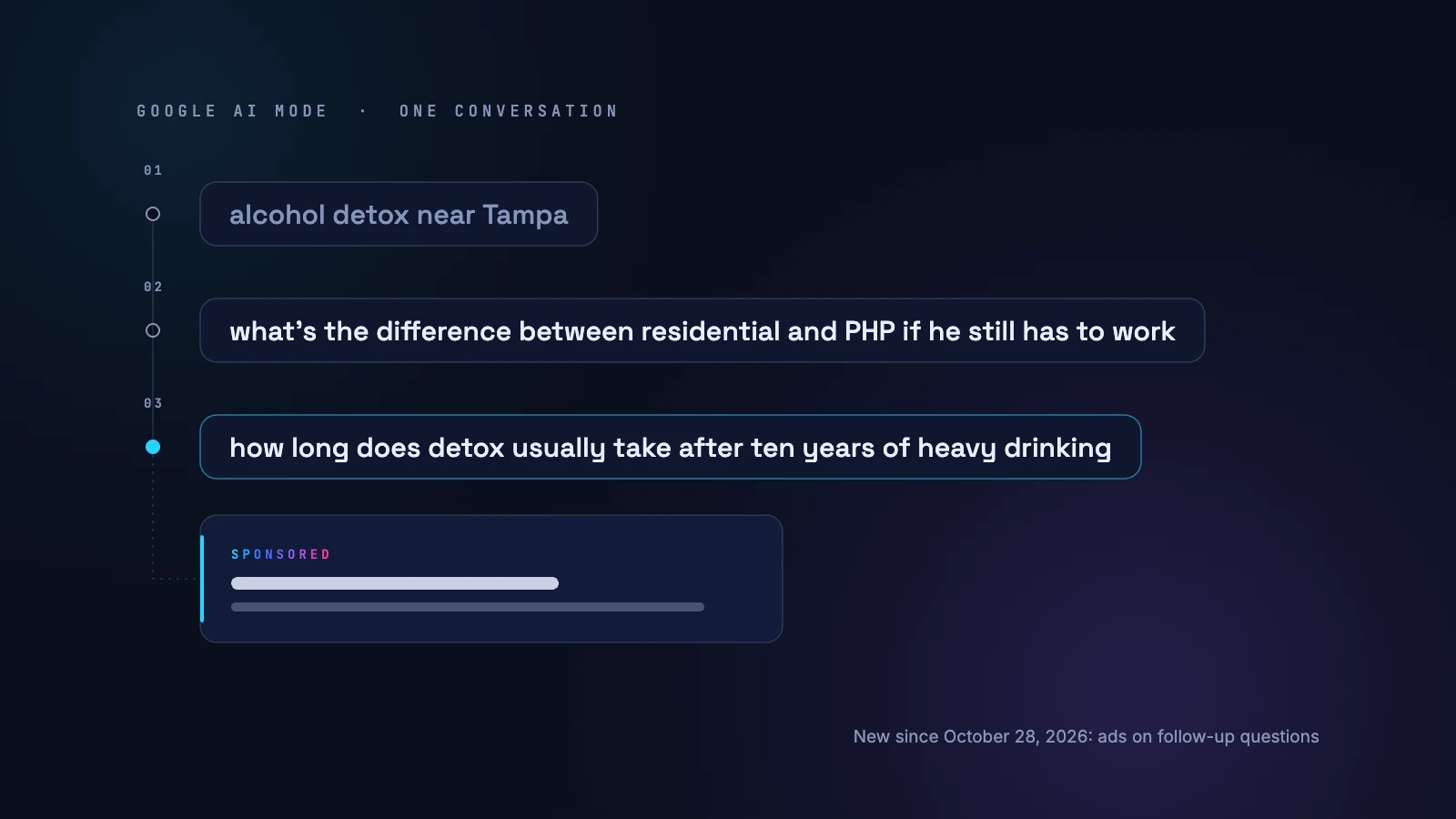
Picture a woman in Tampa on her lunch break. Her husband agreed this morning to get help with his drinking, and she is trying to understand the options before he changes his mind. Her first question is the kind your keyword list already covers. The next two are not.
EligibleExact, phrase, broad, AI Max and Performance Max. A clear commercial query.
New ad slotBroad match, AI Max and Performance Max only. An exploratory question.
New ad slotBroad match, AI Max and Performance Max only. Exact match keywords stay silent here.
An account running only exact and phrase match can show on the first turn and then disappears. By the third question she knows what she needs, and she is close to calling someone. That is the moment multi-turn ads now sell. Whether your center is on the screen depends on choices you made long before AI Mode existed.
The answer is not to switch the whole account to broad match. Broad match with smart bidding can work for treatment centers, but only with strong conversion data and weekly search term review. Left alone, it drifts toward cheap clicks from people researching, not people ready to admit. We cover that tradeoff in our complete Google Ads playbook for treatment centers.
"Broad match without real admissions data is paying for curiosity. Before you open the door to conversational queries, make sure Google knows the difference between a call that admitted and a call that asked about visiting hours."Christian Tanner, Owner, Nava Media
Six moves to make this month
- Confirm your certification covers you. Google's help page says every Google Ads policy applies inside AI experiences. In the U.S., promoting addiction treatment still requires approval under Google's addiction services policy, which runs through LegitScript. If a renewal is coming up, start now. Our LegitScript certification guide walks through the process.
- Open one controlled lane, not the whole account. Build a separate campaign using AI Max or broad match around your highest-fit level of care, with its own budget cap. Keep your proven exact and phrase campaigns untouched. You learn what conversational traffic is worth without risking what already works.
- Teach the algorithm what an admit is. Import qualified admissions back into Google Ads as offline conversions, not just calls over 60 seconds. A broad campaign optimizes toward whatever you count, so count the thing you want. If you are not measuring cost per admission yet, fix that first, and make sure call tracking ties each admit to its source.
- Write one ad that works without pins. The first phase of Google's healthcare test excludes ads with pinned assets or text disclaimers. Many rehab accounts pin headlines to keep messaging tight. Create a second responsive search ad where every headline and description is accurate and on brand in any position, so you are eligible if the test widens.
- Send follow-up traffic to the page that answers the follow-up. Someone who arrives after a third question already knows the basics. Point the conversational campaign at the level-of-care page that answers what they asked, not the homepage. Our guide to marketing by level of care shows how to build those pages.
- Read search terms every week. Conversational queries look different in your reports: longer, more personal, and sometimes far from treatment intent. Add negatives for research topics that never convert, and watch the share of spend going to questions your admissions team cannot help with.
The organic answer sits right above your ad
In AI Mode, the sponsored result shares a screen with an AI-written answer that cites its sources. A family reading that answer about detox timelines will notice whether your center is the one being quoted. Paid and organic now work as one placement. The groundwork for the organic half is in our GEO guide for treatment centers, and if your traffic has already slipped since AI answers arrived, start with what to do when AI Overviews cut your traffic.
"The ad and the answer now sit on the same screen. The centers that win will be the ones Google already trusts in the organic answer, with an ad that picks up the exact question the family just asked."Christian Tanner, Owner, Nava Media