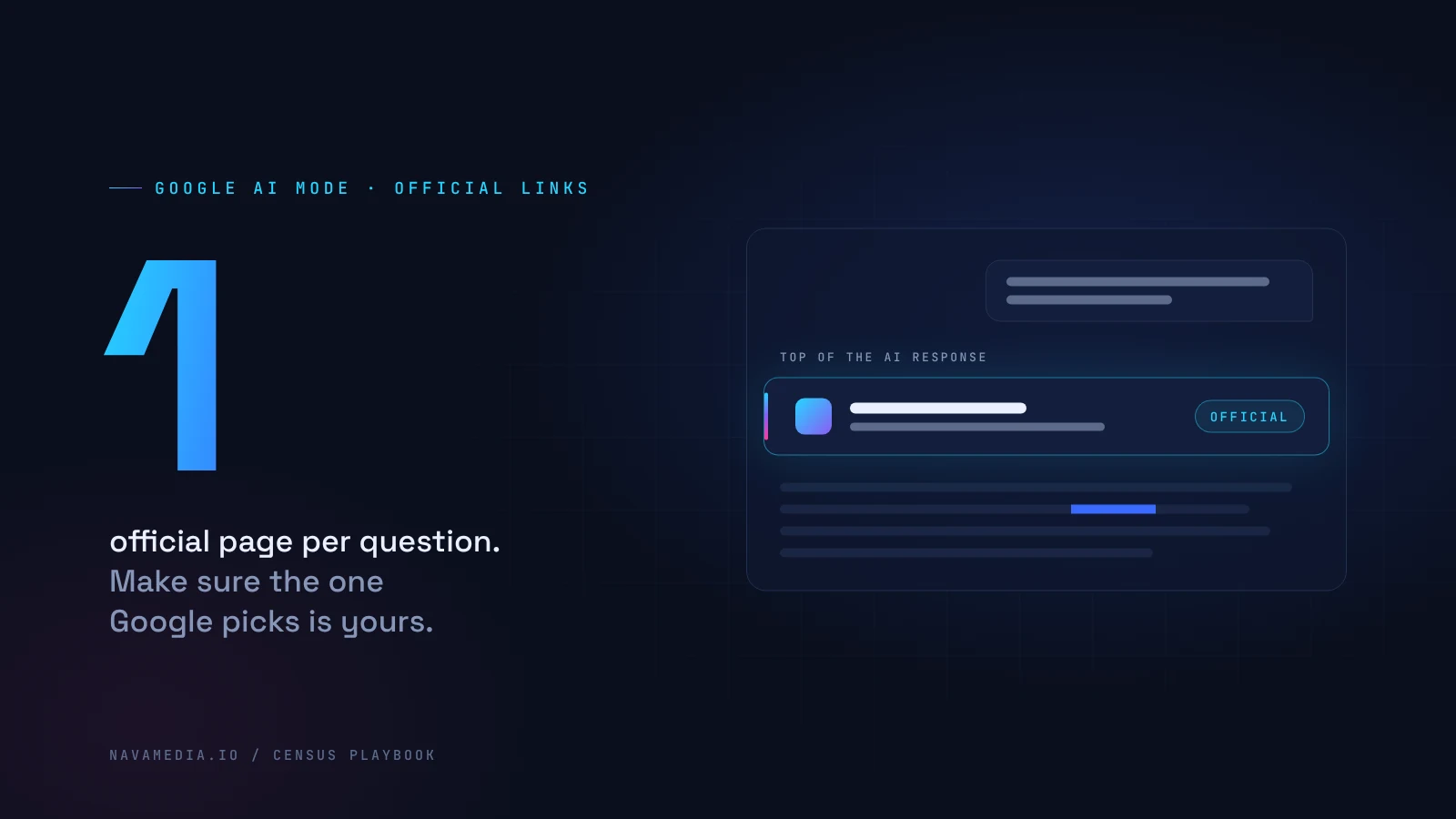
When a family asks Google whether a center works with their plan or how admissions start, Google now wants to hand them a single official link. If your site has one clear page for that answer, the link can be yours. If the answer is spread across a homepage paragraph, a PDF and a third-party directory, Google has to choose something else, and it usually does.
What did Google announce on October 15?
Google announced more links inside AI answers and a test of an official-sites section, in a post by Hema Budaraju, VP of Product Management for Search, titled More ways to connect with the web from Search. Some changes are rolling out and some are still tests:
| Change | Status | What it means for operators |
|---|---|---|
| More inline links in AI Mode and AI Overviews, shown higher in responses | Rolling out | More chances to be clicked from inside an AI answer, if your page is the one cited |
| A section at the top of some responses for the one or two official sites for a task, with a note on why each link is useful | Testing | Navigational questions about your center may get one featured link. It should be yours. |
| News carousels expanding to more locations and languages, highlighting Preferred Sources | Rolling out | Readers who choose their sources see those sources first |
| Thumbnails and a more clickable design for related-article links | Rolling out | A real page image now matters inside AI results |
| Clickable creator and publisher names on video results in AI Mode, linking to Search profiles | Testing | Video from your clinical team can carry your name back to you |
The post includes one number, and it says a lot about where search is heading: people are telling Google which sources they trust, and Google is building the interface around those choices.
Growth in people using Google's Preferred Sources feature since the start of 2026.
"For two years, the fear was that AI answers would swallow the click. Google is now saying, in writing, that it wants to send people to the official page. The question for every operator is simple: when a family asks about you, is there an official page to send them to?"Christian Tanner, Founder, Nava Media
What does this look like from a family's side?
A family sees one answer and, under this test, one official link to act on. Picture a father in Orlando on his lunch break. His daughter agreed this morning to get help, and he wants to call someone before the afternoon is gone. He types the name of a center a friend mentioned and asks whether it works with his plan. Google's AI answer summarizes what it found and, if the test applies, puts the official place to answer that question at the top.
If the center has a clear insurance page that names the plans it works with, that is the link. If the only insurance information lives in a homepage paragraph or on a directory profile, Google has to pick something else. That is not only a ranking problem. It is an admissions problem that happens to show up in search.
"Families in crisis don't browse. They ask one question and tap one link. Every important question should have exactly one page on your site that answers it, written for a scared parent, not for a keyword tool."Christian Tanner, Founder, Nava Media
Which pages count as official for a treatment center?
The pages that count are the ones that complete a family's task in one place. Google has not published eligibility rules for the official-sites section, so treat this as a working hypothesis, not a guarantee. The pattern Google describes is a task with one or two right destinations, and for a treatment center those tasks are predictable.
If you cannot point to one URL for each of these, you have a gap. If you can point to three URLs for one of them, you have a different problem: you are splitting the signal and asking Google to guess. We cover the broader version in how AI engines choose which rehabs to recommend, and the page-level craft in how to structure content so AI engines can quote it.
How do you make your page the official one?
Make each answer easy to find, easy to quote and identical everywhere it appears. Google's own guidance says there are no additional requirements to appear in AI Overviews or AI Mode: the page has to be indexed and eligible for a snippet, its structured data should match the visible text, and business details should be current. These six moves follow from that.
- Map your official pages. Write down the five to eight questions families ask before calling and assign one URL to each. Retire or redirect duplicates, including old landing pages that still rank.
- Answer in the first two sentences. The insurance page should say which plans you work with, right at the top. The admissions page should give one phone number and the hours the line is staffed. Put the detail below.
- Name things the way families do. Use "Does [center] take Blue Cross?" language in headings, not internal jargon. AI answers match questions to pages, and the closest match wins.
- Make every fact agree. Your phone number, address, hours, levels of care and accepted plans should match across your site, your Google Business Profile and your Organization schema. Conflicting tracking numbers are the most common break we see, and they are a big reason directories outrank treatment centers in AI answers.
- Give each page a real image. Related-article links now carry thumbnails. A stock sunset says nothing. A clean photo of your actual facility says you are real.
- Put your clinicians on video, under your name. Google is testing clickable creator names on video results in AI Mode. Short, plain-spoken videos from your medical director or clinical lead, on a channel tied to your brand, are a way to be the name attached to the answer.
None of this requires a new tool. It is the same discipline behind our SEO and AI search work for treatment centers: one clear page per question, facts that agree everywhere, and proof that a real organization stands behind them.
Does this change anything for Google Ads?
No. The October 15 update covers organic AI features. Promoting addiction treatment with Google Ads in the United States still requires approval under Google's addiction services policy. Paid placements inside AI Mode are moving on their own track, which we cover in Google ads now follow the conversation in AI Mode. The two now share a screen, so the page you build for the organic answer is also the best landing page for the ad.
"This is not a hack and there is no trick to it. Google is rewarding the center that makes the truth easiest to find. That has always been good admissions practice. Now it is also how you earn the link."Christian Tanner, Founder, Nava Media